
Summary: Artificial intelligence (AI) queries are not replacing traditional search. Rather, they are changing how people discover brands online.
- AI-generated answers—responses AI systems produce—are becoming a more common feature within traditional search experiences, especially in Google’s ecosystem.
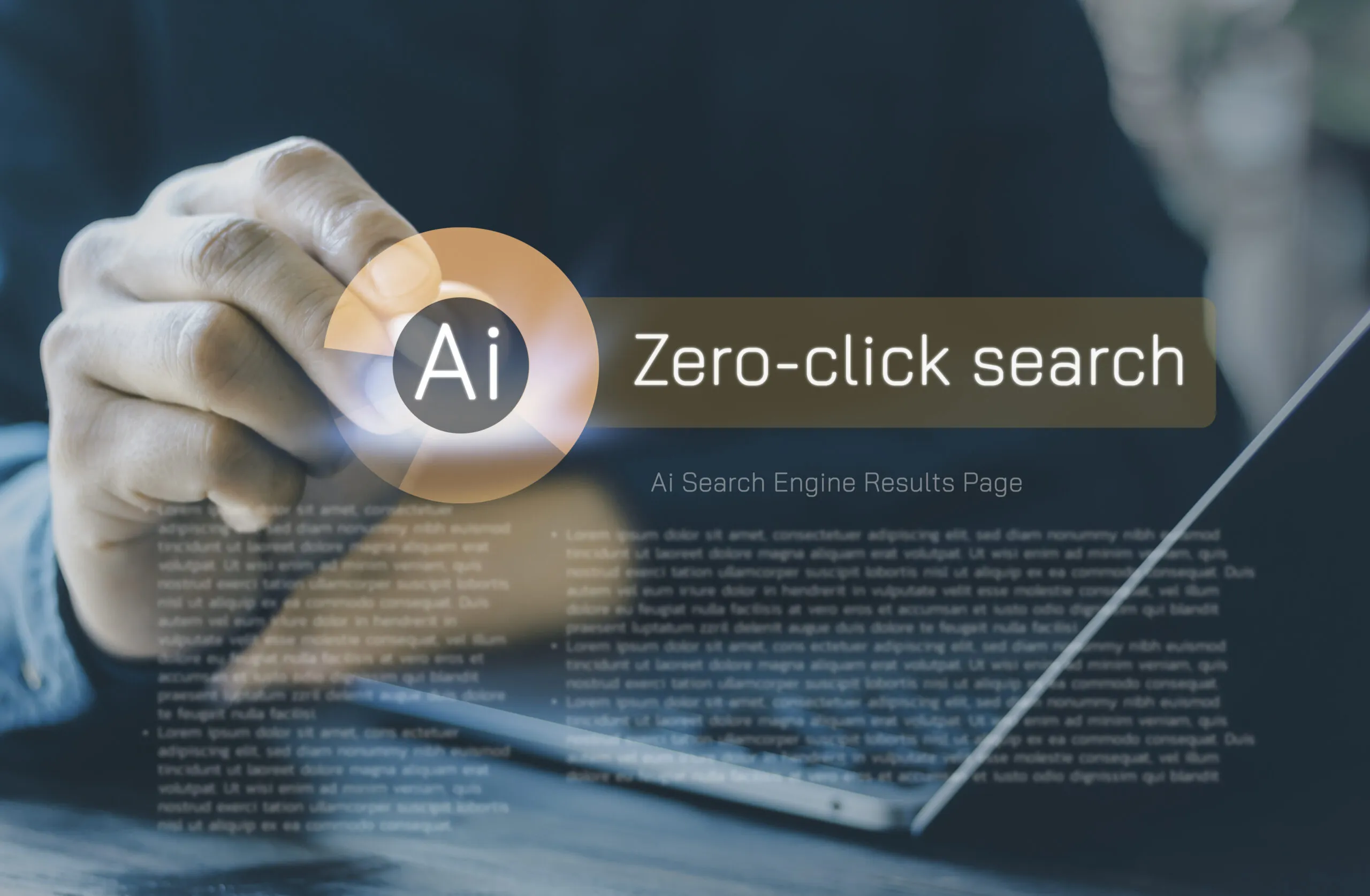
- More online users receive AI-generated answers without clicking through to websites, leading to growth in zero-click search experiences (search interactions where the user gets their answer directly and never clicks through to a website).
- Visibility in AI-generated answers and citations is an important and distinct discipline that operates alongside traditional search engine optimization (SEO).
- Traffic—direct or indirect—from AI tools tends to be higher quality than visitors from other traditional sources.
- Measuring different elements of AI visibility will help brands calibrate their AI visibility and generative engine optimization (GEO) strategy.
AI Queries Have Become an Increasingly Important Complement to Traditional Search
As anyone who has used Google at all in the last couple of years has seen, AI Overviews (Google’s AI-generated summary answers that appear above traditional organic results) are showing up for a growing share of Google queries. Recent data supports this, notably a July 2026 article from TechCrunch, which references a report from SimilarWeb:
“In just a year’s time, Google’s AI-generated answers in search, known as AI Overviews, have gone from appearing in 15% of searches to 43%… what began as an AI layer on top of search has become an integral part of the search journey itself, as Google drops users into AI Overviews, where they can then continue their research via Google’s more conversational AI Mode”
In addition, Google AI Mode is encouraging significantly longer, more conversational searches and the number of follow-up searches is growing as people have ongoing conversations with Google’s search/AI ecosystem. A result of this is that search behavior is becoming more exploratory and research oriented.
Further evidence of the growing use of AI tools, Google’s rivals also report large numbers of users:
- Earlier in 2026, OpenAI announced its ChatGPT tool reached 900 million weekly active users, along with 50 million paid subscribers.
- In July, Claude reached 245 million active users across the web and its mobile app.
The implications are clear: Businesses should stop optimizing exclusively for short keyword searches and begin optimizing for questions, comparisons, recommendations and conversational discovery (marketers often refer to this strategy as GEO, or generative engine optimization).
Zero-Click Online Experiences Are Becoming More Common
As more online users are relying on AI tools (not just Google’s suite of products, but Claude, ChatGPT and others) for online questions, we are seeing a steady rise in the number of the zero-click online sessions.
Rand Fishkin of SparkToro identified this trend early on. His most recent commentary on zero-click experiences makes clear which way things are going: fewer clicks to non-Google websites:
“Thanks to AI features, instant answers, UI elements that keep searchers in the results, and shifting user preferences, Google is becoming a walled garden… Ten years ago, ~45% of Google searches were zero-click. Today it’s 68%. That’s a 33.8% increase (23 points) in a decade.”
AI chatbots outside of AI Mode, Gemini and AI Overview also tend to keep users on their sites as these platforms answer questions without requiring an external website visit. Reliable data are hard to find, but a consistent pattern has emerged: websites across the internet are experiencing declining traffic from traditional search sources, as users are getting answers or information directly from search or AI answer engines.
Some data points that illustrate this point:
- A leaked file from OpenAI reported by MarTech reveals that click-through rates (CTRs) from AI-generated answers for select pages ranged from 0.0% to 1.68%. By contrast, CTRs for organic Google searches are still higher, ranging from ~40% in position 1 to 1.6% for position 10 (according to FirstPageSage).
- According to SimilarWeb data, only 0.2–0.6% of total website traffic for B2B brands is referred via Perplexity.
- While Cloudflare reported that global internet traffic actually rose 19% in 2025, a lot of that growth was bots—not humans.
Website Visits from AI are More Valuable than Traditional Search Traffic
Now, there is evidence that the traffic that websites do actually get from AI chatbots is much higher quality than traditional organic search traffic. That’s because the AI tools are doing much of the evaluation for the user. So rather than sifting through ten blue links (which are often pushed far down the search engine results page (SERP), AI users are getting a more complete answer to their initial query and feel more confident when making a choice to visit a website. In short, they arrive on websites pre-qualified.
Recent research seems to back up this assertion that AI traffic tends to be more valuable:
- Adobe’s Q1 2026 data show that AI referral traffic converts 42% better than non-AI traffic. AI-referred shoppers also generate 37% more revenue per visit and spend 48% longer on-site, arriving effectively pre-qualified after engaging with an AI tool.
- NP Digital’s recent report asserts that AI-referred website visitors convert at a 5.97% rate vs. 0.73% for traditional traffic. Time to conversion for AI-referred visitors is 62% faster than for traditional traffic, and revenue is seven-times higher.
- CartFlows reports that in 2026, AI referral traffic has converted at 5.8%, the highest of any channel.
One important note: Fishkin correctly points out that an AI-generated answer will not always spur an immediate website visit, but instead often leads to a separate search (usually branded). Google will take credit for this last-click attribution, either via organic search or an ad click, but it may in fact have been catalyzed by a query in an AI tool.
What Should Brands and Marketers be Measuring Now?
Website traffic remains important, brands should measure AI visibility beyond clicks. Rather than relying solely on traditional referral website metrics, businesses should be measuring:
- Brand Mentions in AI-generated Answers: This can be done in a number of ways. The easiest way is simply to ask several AI tools the same question about your industry (“Tell me the best real estate investment and land development business in Texas.”) or about your business in particular (“I’m considering buying quantum computing hardware for my business from Lumivex Systems. What are the pros and cons of purchasing from Lumivex?”). Then assess if and how the generative answers cite your brand or products. Save these prompts and repeat them regularly and track the progress of your brand. This is not a precise method, but will provide a basic tracking protocol.
A more rigorous (and expensive) method for tracking brand mentions in AI-generated answers is to use tools such as Visto,* Otterly.AI, SEMRush, Ahrefs or others. These AI visibility tools can usually track not just mentions of your brand in AI-generated answers, but your share of voice compared to your competitors. - Share of Voice in Generative Answers: Share of voice measures presence across large prompt samples, providing a relatively reliable view of how often AI-generated answers include a brand and its rivals. A company with a smaller share of voice than its competitors will likely have weaker awareness and a lower online profile, and thus have a harder time ultimately garnering qualified traffic to their website.
- Citation Frequency in AI Answers: AI citations are different than brand mentions. AI citations measure whether a source is directly referenced and whether content is linked or cited. Tracking citations can be conducted in the same way as brand mentions but have a different value.
A brand can receive many citations and few AI mentions (like Wikipedia). Or it may receive many brand mentions and relatively few citations (like Google or Apple). While mentions in AI tools can help raise the profile and awareness of a brand, citations are more likely to lead to traffic back to the source’s website (although the amount of website visits is still likely to pale in comparison to traditional search traffic). - How “AI-friendly” Your Website is: Many of the tools already cited (and others such as the AI Friendliness Scanner,**) test how easily AI search engines and chatbots can read and understand your web pages. This kind of analysis typically evaluates some combination of the following factors on a website. Taken together, these metrics help digital marketers effectively evaluate existing owned content on your website and add, edit, or improve it to increase likelihood of being indexed, used and cited by AI tools:
- AI Crawler Accessibility: Which tools are allowed to access your sitemaps without being blocked. This helps you ensure that the important LLMs can access and index your site content.
- Schema Markup: Which key pages use helpful JSON-LD schema, thereby allowing AI tools to more easily identify the kinds of content on a given page.
- Meta Data: Is there helpful and complete meta data—like titles, meta descriptions and alt tags—that allow AI bots to more easily identify page content.
- Authority, Clarity, and Trust: This is very similar to traditional E-E-A-T factors (experience, expertise, authoritativeness, and trustworthiness) from traditional SEO.
- Currency of Content: AIs seem to favor more recently published content with current statistics, data and references, so knowing which content is outdated or obsolete is important.
- Direct Brand Searches in Google: As noted earlier, visibility in AI-generated answers can help improve visibility for a brand. But the traffic generated from this visibility often comes from a different source, mostly Google searches. So, it’s important to track the number of branded searches for your brand over time and correlate that with your AI visibility. If AI brand visibility is rising in parallel with branded searches and website visits from these branded searches, it’s fair to conclude that brand mentions in AIs are helping drive high-quality traffic to your website. (You can track this most easily in Google Search Console.)
- Website Traffic Directly from AI Tools that Leads to Conversions: The initial numbers are likely to be small, and some conversions from AI can be attributed to organic search from Google. And tools like HubSpot do have the capability to identify which leads or conversions came directly from AI tools. Knowing how many new customers, clients or purchases came directly from which AI websites will help business calibrate their AI visibility strategy going forward.
The Bottom Line: AI Visibility Is Critical for Businesses in 2026
In short, brands that show up in AI-generated answers can earn higher-intent, higher-converting traffic, even if that traffic arrives in smaller volumes and through more indirect routes than years of SEO practice trained marketers to expect.
So, it’s important for businesses who want to continue to grow to treat AI visibility as a core discipline. And I’ve outlined some of the key factors to consider when developing an AI visibility strategy:
- Expect traffic from traditional sources to continue to erode
- Website visitors from AI tools are likely to be farther down the conversion funnel
- Invest in effective measurement tools to assess and track AI visibility
- Use the learnings from your analytics to enhance or improve owned online content
Because GEO isn’t a replacement for SEO, but a complementary layer built on top of and alongside it.
If you’re still not sure where to start, open a few AI tools, ask the questions your customers are already asking, and see who shows up. If it isn’t you, that’s your starting point.
* Pierpont Communications is a subscriber to Visto and uses it as our AI-visibility measurement tool.
** The AI Friendliness Scanner is a product of MantyWeb, who provides web support for Pierpont Communications.
FAQs
What is the difference between SEO and GEO?
The difference between SEO (search engine optimization) and GEO (generative engine optimization) is the split between ranking in traditional organic search answers and being included or cited by answers generated by AI tools. Don’t think about SEO and GEO as competing against each other. GEO builds on the same foundations as SEO (authority, clarity, structured data) but optimizes for how AI systems synthesize and cite content so that a brand can be included in an AI-generated answer and/or the cited online sources. SEO focuses on ensuring key pages on a brand’s website rank in SERPs.
Does a zero-click search mean my website gets no value from that search?
Zero-click searches do not mean your website gets no value from that search. Even when a user doesn’t click on a link in organic search results or in an AI-generated answer, being cited or mentioned can build brand awareness and can influence a separate search later on. In addition, website traffic referred by AI responses tends to be more qualified and converts at a higher rate than traditional organic traffic.
How can I tell if my brand shows up in AI-generated answers?
The simplest way to tell if your brand shows up in AI-generated answers is to manually ask several AI tools the same questions your customers would ask. These questions should take two forms:
- Questions about your industry broadly, without naming your brand, company or products (for example, “I’m looking for the best company to provide cybersecurity for a mid-sized medical technology company. Tell me the best ones and what the pros and cons are for each of them.”)
- Questions about your specific brand names (for example, “I’m considering hiring [Company Name] to provide cybersecurity for my business. What should I know about [Company Name] before reaching out to them?”)
For more rigorous, ongoing tracking, dedicated AI-visibility platforms—such as Visto, Otterly.AI, SEMRush, or Ahrefs—measure brand mentions, citation frequency, and share of voice against competitors.
What’s the difference between a brand mention and a citation in AI answers?
A brand mention means an AI tool references your company, brand, or product by name in its generative answer. A citation means the AI directly links to or attributes content from your website as a source. A brand can have many mentions with few citations (like Apple or Google, which are often referenced without a link) or many citations with fewer mentions (like Wikipedia). Citations are more likely to drive an actual website visit, though far fewer than traditional search traffic.