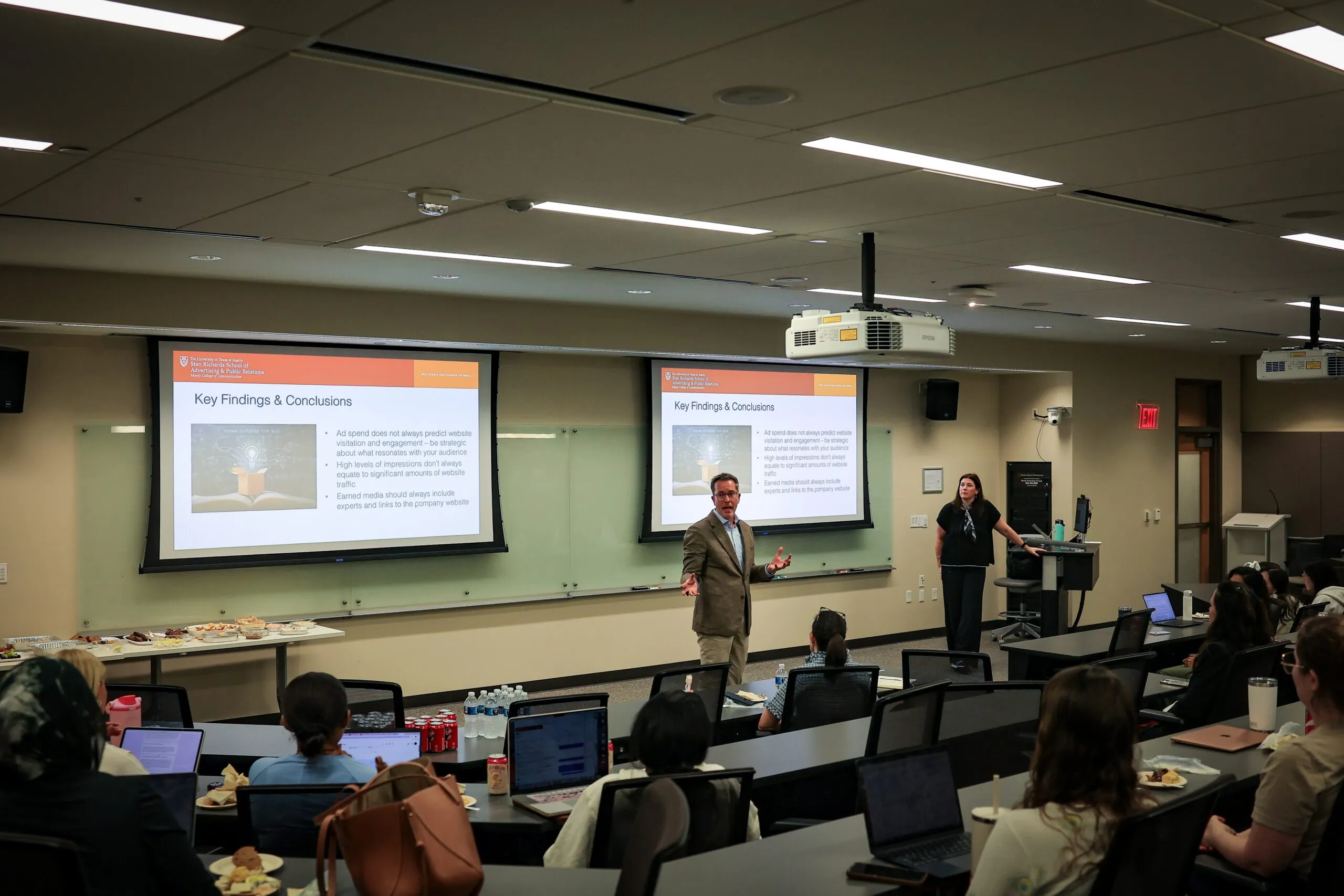

Recently, I had the opportunity to participate in a meaningful and intellectually energizing event at the University of Texas (UT) at Austin: The Nelson Center Research Showcase, organized by Laura Bright, PhD.
Prof. Bright is Associate Professor of Media Analytics in the School of Advertising and Public Relations and the Co-Director of the Nelson Center for Brand and Demand Analytics in the Moody College of Communication.
The showcase brought together faculty, students, and industry practitioners to highlight how rigorous academic research can—and should—inform real-world marketing and communications practices.
As someone with an academic background (I have PhD in Health Policy from UTHealth Houston) who sits squarely at the intersection of data, strategy, and execution, this session fortified my belief that continued partnerships between industry and academia are essential.
Research Built on Real-World Data
One of the three research projects presented at the showcase was particularly important to me and Pierpont.
“Paid, Earned, and Owned Social Media Engagement Modeling for B2B Marketing,” was authored by Prof. Bright, Matthew S. Eastin, Gary B. Wilcox, Allison Agathe, and myself. The research was based on anonymized data provided by Pierpont Communications and one of our B2B technology clients (who remained anonymous for confidentiality reasons).*
The goal of the research was to determine if we could use statistical modeling to identify which external communication factors actually drove website traffic during a 13-month period.
Rather than relying on surface-level engagement metrics or correlations, the study examined the relative impact of paid media, earned media, and organic (owned) social media activity on website views—one an important performance indicator for B2B marketers and for this technology client.
Findings That Challenged Assumptions
Some of the findings were genuinely surprising.
Perhaps most notably, the amount of channel spend was not significantly related to website views. For example, Google Ad impressions were by far the highest of any channel analyzed, yet they showed no statistically significant relationship with increased website traffic.
On the flip side, Instagram post impressions—by far the lowest in volume—demonstrated a positive and statistically significant relationship with website views.
For a B2B technology company, this result runs counter to conventional wisdom. I typically dismiss Instagram as a largely B2C platform, assuming it’s better suited for lifestyle brands than enterprise technology firms. And yet, the data told a different story.
What this reinforces is something many practitioners intuitively sense but struggle to prove: not all impressions are created equal, and high-volume channels do not automatically translate into meaningful outcomes.
Moving Beyond Vanity Metrics
This research also matters because marketers are still too often pressured to evaluate performance using vanity metrics like follower counts, impressions, reach, and surface-level engagement. While these measures can offer directional insight, they are not always predictive of actual behavior, such as visiting a website, downloading content, or entering a sales funnel.
Just as importantly, these metrics can’t always isolate the true impact of individual channels within an integrated brand communication strategy. Paid, owned, shared, and earned media don’t operate in silos, and without a consistent evaluation framework, it’s difficult to understand which tactics are truly driving results.
Our study demonstrates the value of objectively evaluating all communication tactics using a robust analytical lens, one that assesses each channel’s contribution, interaction, and relative importance.
Why This Matters for the C-Suite
With increasing pressure from executive leadership to demonstrate measurable returns on marketing investment, marketers have to allocate limited resources.
Insights from this analysis give brands the ability to:
- Reassess how earned, owned, paid, and shared media contribute to KPIs
- Identify underappreciated channels that may be punching above their weight
- Strategically reallocate resources toward tactics that actually move the needle
For the client involved in this study, the findings opened the door to rethinking digital and public relations investments—particularly around earned and organic social strategies that demonstrated outsized impact relative to spend.
The Power of Industry–Academic Partnership
One of the most rewarding aspects of this project was the collaboration itself.
This research initiative is part of an endowment Pierpont Communications established at UT in 2015 to support research investigating communications issues that impact the business world.
From my perspective, the endowment and the research it produces represent a mutually beneficial relationship:
- Agencies and their clients gain credible, peer-reviewed insights grounded in real data
- Professors and students gain access to real-world datasets rarely available in academic settings
I firmly believe this is a model our industry should pursue more aggressively. The challenges we face regarding measurement, attribution, and results are often too complex to solve in isolation.
Additional Research Highlights
In addition to our paper, two other research projects were presented at the showcase, each addressing critical issues facing the advertising and marketing profession:
- “I’m In This Industry and I Don’t Know How to Protect My Data’: An Exploration of Advertising Practitioner’s Perceptions and Solutions to Consumer Data Privacy Regulation”
Authored by Pooja Iyer and Prof. Bright, this paper explores how higher education can better prepare future practitioners to navigate the growing complexity of data privacy and regulation. - “Navigating a Paradigm Shift: Technology and User Acceptance of Big Data and Artificial Intelligence Among Advertising and Marketing Practitioners”
Authored by Pooja Iyer and Prof. Bright, this research examines how big data and AI are reshaping the industry and what organizations can do to improve practitioner acceptance through training, collaboration, and transparency.
Looking Ahead To Further Research Opportunities
The Nelson Center Research Showcase reinforced my belief that partnerships like the one we have with UT can provide invaluable insights for professionals and academics interested in marketing and PR.
I’m grateful to Prof. Bright and the Moody College team for their leadership and partnership—and I look forward to continuing this work together.