
When we first wrote about how artificial intelligence was changing digital advertising in our 2025 analysis, ads inside AI tools were not widespread. Platforms like ChatGPT, Claude, and Google’s Gemini were gaining rapid adoption, and early experiments suggested that advertising would eventually move beyond keywords and search results into conversational experiences.
At the time, this shift felt inevitable but distant.
That has now changed.
In February 2026, OpenAI began testing ads directly inside ChatGPT for users in the United States. This marks the first large-scale attempt to monetize conversational AI through advertising.
For business leaders and marketers, this is an important moment because AI tools are no longer just influencing how people research and make decisions. They are transforming into digital ad platforms that businesses will have to consider using to stay visible online.
This development raises some important questions:
- How will advertising function inside tools people trust for research and decision-making?
- How can companies protect credibility when ads appear next to AI-generated answers?
- And what does this shift mean for customer discovery, brand trust, and long-term growth?
From early signals to real placements: What has changed
In our earlier analysis, we described advertising in AI systems as early-stage but potentially consequential. At that point, most LLMS were simply testing, not rolling out fully developed products. Google was experimenting with ads in AI-powered search summaries. Perplexity was testing sponsored follow-up prompts. Much of the conversation focused on what might happen.
Since then, the landscape has accelerated on multiple fronts. Google has rolled out ads within AI Mode and AI Overviews, extending sponsored placements into AI-generated search summaries. And OpenAI has moved from theory to practice with a structured ad program inside ChatGPT.
How ads work in ChatGPT today
According to OpenAI, ads are currently being tested for logged-in users on ChatGPT’s Free and Go plans. Paid tiers, including Plus, Pro, Business, Enterprise, and Education, remain ad-free. Ads appear below the end of a ChatGPT response and are clearly labeled as sponsored content, visually separated from the AI’s answer.
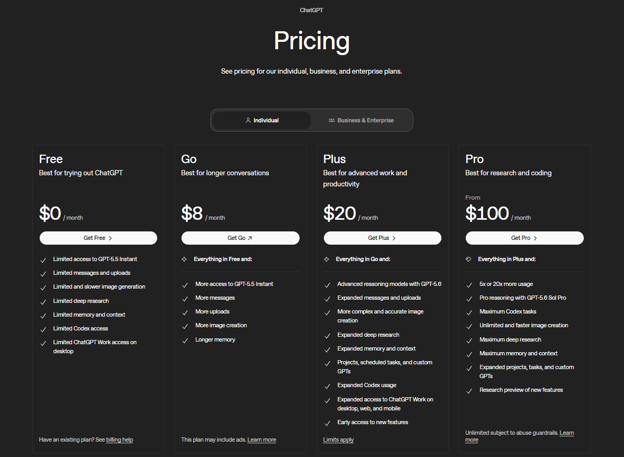
Source: chatgpt.com/pricing/
OpenAI has claimed that ads do not influence the responses ChatGPT provides. Advertising runs on a separate system, and ads are matched to the topic of the conversation rather than inserted into the response itself. Advertisers do not receive access to individual conversations and only see aggregated performance data such as impressions and clicks.
This distinction matters. OpenAI is attempting to preserve the integrity of the AI’s output while still introducing a revenue model that supports broader access to the tool.
What began as a U.S.-only pilot has expanded quickly. In March 2026, OpenAI extended ad testing to Canada, Australia, and New Zealand. By May 2026, the company announced pilots in the UK, Mexico, Brazil, Japan, and South Korea. OpenAI has also introduced a self-serve Ads Manager with CPC and CPM bidding options and no minimum spend requirement, making the platform accessible to businesses of all sizes, not just enterprise advertisers.
How ads work in Google AI Mode and AI Overviews today
Google has taken a different structural approach. Rather than placing ads below a single response, it embeds them above, below, or within AI Overviews, the AI-generated summaries at the top of many search results. These ads run through Google’s existing search auction and are drawn from campaigns advertisers already run, such as Search, Shopping, and Performance Max, though advertisers cannot target the AI placement directly or opt out of it.
At Google Marketing Live 2026, Google introduced new Gemini-powered formats for AI Mode, including Conversational Discovery ads, Highlighted Answers, and AI-Powered Shopping Ads, that live inside the AI response itself. As with ChatGPT, the ads are clearly labeled and excluded from sensitive categories such as health, finance, gambling, and politics. The scale is significant: AI Mode has surpassed one billion monthly users, and AI Overviews reach roughly 2.5 billion.
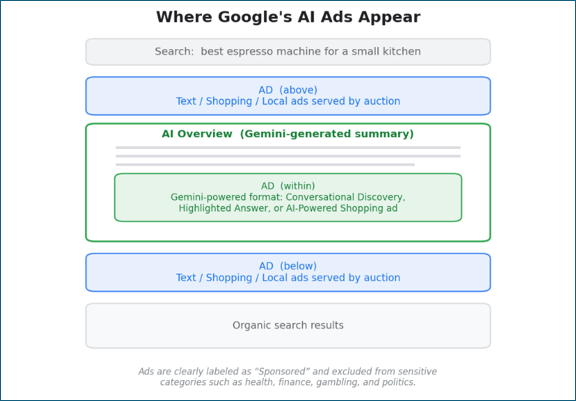
Source: Pierpont Communications analysis; ad placement details per Google Ads Help.
Why business leaders should care about AI advertising
According to MediaPost.com, Major advertising agencies, including Dentsu, Omnicom, Publicis, and WPP, are already participating in early tests, alongside technology integrations from Adobe, Criteo, Kargo, Pacvue, and StackAdapt. That level of industry investment signals strong confidence in the format’s potential.
The interest is easy to understand. ChatGPT now has more than 900 million weekly active users (per Tech Crunch), many of whom use the platform to research products, evaluate options, plan purchases, and solve real business problems. CNBC reports that OpenAI generated approximately $100 million in ad revenue within its first six weeks of testing, underscoring the scale of demand from advertisers.
For the first time, companies may be able to reach customers at the exact moment they are forming decisions, not before or after, but during the process itself.
The opportunity: Reaching customers inside decision moments
One of the most significant implications of conversational AI advertising is how closely it aligns with real intent.
Conversations reveal context, not just queries
Traditional search relies on short phrases that only partially reflect what someone wants. Conversations that can occur in LLMs provide much more detail and context, as explained in this report from Adobe for Business: “Users are asking full, contextual questions instead of typing short keyword inputs, and refining their thinking through follow-ups.” When advertising is aligned with that context, it has the potential to feel more relevant and helpful.
For example, a user may ask AI assistant to compare software platforms, plan a major purchase, or evaluate vendors is already in an active decision phase. In those situations, a clearly labeled, well-matched ad can enhance the relevancy of the answer rather than interrupt it.
A new type of advertising environment
Conversational ads do not compete to be the primary answer. They appear after the AI has already delivered value. That means that AI ads must earn their place by being useful, timely, and respectful of the user experience.
For organizations, this requires a different mindset. Messaging that works in traditional search or social media may feel out of place in an AI-driven conversation. The emphasis shifts from grabbing attention to supporting decisions or expanding options.
Rethinking success metrics
As we noted previously, AI-driven experiences challenge traditional measurement models. In conversational environments, success may not be defined solely by clicks or immediate conversions.
Instead, outcomes may include assisted decisions, reduced research time, stronger brand trust, or faster movement through a buying process. Leaders should expect measurement frameworks to evolve as these formats mature.
The risk: Trust, transparency, and brand credibility
If the opportunity lies in intent, the risk lies in losing trust.
OpenAI’s safeguards and their importance
OpenAI has emphasized that ads are clearly labeled, separated from responses, and do not influence answers. Users retain control over personalization, and ads are excluded from certain sensitive topics.
Google applies comparable safeguards. Ads placed within AI Overviews are excluded from sensitive categories such as health, finance, gambling, and politics, and users can turn off ad personalization, limit sensitive ad topics, or delete their activity data through My Ad Center. Google has also expanded transparency with a ‘How this ad was made’ disclosure that flags when generative AI was used to create or edit an ad.
These safeguards exist for a reason. People increasingly rely on AI tools for important decisions related to work, finance, education, health, and other personal matters. If users begin to question whether advice is shaped by advertising, trust can erode quickly.
A contrasting approach from competitors
At the same time OpenAI introduced ads, its competitor Anthropic took a public stance against advertising inside its AI assistant, Claude. Anthropic argues that AI conversations are fundamentally different from search or social feeds and should remain focused on thinking and problem-solving rather than monetization.
Anthropic reinforced this position through a high-profile Super Bowl campaign that highlighted the discomfort of ads appearing during personal or sensitive conversations. The message was clear: not every platform believes advertising belongs everywhere.
For executives, this contrast matters. It signals that AI platforms will differentiate themselves not just on capabilities, but on business models and values. Companies will need to decide where their brands fit within those ecosystems.
Brand safety in AI environments
Advertising alongside AI-generated content introduces new brand safety considerations. While platforms promise safeguards, organizations must establish their own guidelines around context, tone, and appropriateness of showing ads in AI-generated content.
Appearing in the wrong conversational setting can damage credibility faster than a poorly placed banner ad ever could.
What leaders should consider now
AI advertising is still early, but it is no longer experimental. Business and marketing leaders should begin considering the implications now rather than reacting later.
1. Understand how customers use AI to make decisions
Identify where AI fits into your customers’ research and buying journeys. Are they using these tools for early exploration, vendor comparisons, or final decisions? This understanding will shape whether and how conversational AI advertising makes sense for your organization.
2. Define trust and brand boundaries
Determine where your brand should appear and where it should not. Align marketing, communications, legal, and leadership teams around clear standards for transparency, tone, and risk tolerance.
3. Prepare for new measures of value
Not every meaningful interaction produces a click. Leaders should be prepared to evaluate AI advertising through a broader lens that includes influence, credibility, and long-term customer relationships, not traditional clicks.
The direction is clear: AI advertising is coming
Just as search advertising reshaped business strategy over the past two decades, conversational AI will influence how organizations are discovered, evaluated, and trusted online. The companies that succeed will not be the ones that move fastest, but the ones that move thoughtfully.
The AI advertising era has begun. The strategic decisions made today will shape how brands are perceived in this new environment tomorrow.
Key takeaways about AI advertising
The introduction of ads inside ChatGPT, Google AI and other LLMs represents a fundamental shift in where and how customers encounter brands during their most consequential decision-making moments. At the same time, the divergence between platforms like OpenAI and Anthropic underscores that the AI ecosystem is not monolithic. Where a brand chooses to appear, and where it does not, will carry meaning.
For organizations, the priority now is preparation: understanding how your customers use AI tools, establishing clear guidelines for brand presence in conversational environments, and building the internal capabilities to evaluate new forms of influence that go beyond clicks and impressions. The companies that approach this shift with intention and discipline will be best positioned as AI reshapes the landscape of customer discovery and trust online.